|
Your
Country
|
|
Chengdu
|
|
Sichuan---East
|
|
Ancient
Town
|
 |
|
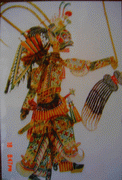
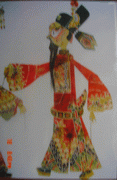
The shadow show
The
shadow show or leather silhouette play is a type of drama
which has its roots
in China.
Legend has it that Emperor Wudi (156-87 B.C.) of the Western
Han was depress-ed with the death of his favourite concubine
Lady Li. To help him get over the sad-ness, an occultist
sculptured a wooden figure in the likeness of the lady and
projec-ted its shadow on a curtain for the emperor to see,
bringing him consolation with the belief that the shadow was
her spirit. This has been thought to be the beginning of the
shadow show.
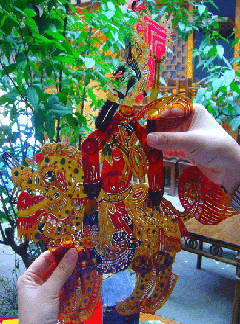
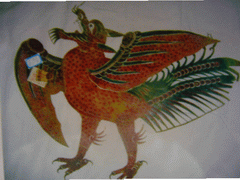
Today's shadow puppets are made of leather instead of wood for the
simple rea-son that leather is much lighter, easier to
manipulate and carry round. The process for making the
puppets is as follows: Sheep or donkey skin with hair
removed is cle-aned and treated chemically to become thin
enough to be translucent. Coated with tung oil and dried, it
is carved into various parts of dramatic figures. The trunk,
he-ad and limbs of a puppet are separately carved but joined
together by thread so that each part may be manipulated by
operator to simulate human ovements.The leather puppets are
painted with various colours to show their different
qualities kind or wicked, beautiful or unly. During the
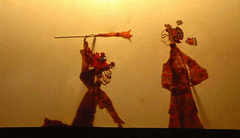
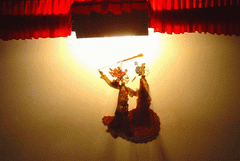
performance, the "actors" are held close to a white curtain
with their coloured shadows cast on it by a strong light
from behind.
Moved by guiding sticks, they play the roles, accompanied by
music, with their parts or singing done by the operators.
The plays can be quite dramatic and, when it comes to fairy
tales or kungfu stories, the "actors" may be made to ride on
clouds or perform unusual feats, to the great enjoyment of
the audience, especially chil-dren.
The shadow show became quite popular as early as the Song Dynasty
(960-1279) when holidays were marked by the presentation of
many shadow plays. During the Ming (1368-1644), there were
40 to 50 shadow show troupes in the city of Beijing alone.
In the 13th century the shadow show became a regular
recreation in the barra-cks of the Mongolian troops. It was
spread by the conquering Mongols to distant countries like
Persia, Arabia and Turkey. Later, it was introduced to
Southeastern Asian countries, too.
The show began to spread to Europe in the mid- 18th century, when
French mis-ionaries to China took it back to France in 1767
and put on performances in Pads and Marseilles, causing
quite a stir. In time, the ombres chinoises, with local mod-ification
and embellishment, became the ombres francaises and struck
root in the country.
As present, more than 20 countries are known to have shadow show
troupes.
Some people may have gone too far in alleging that the
Chinese shadow show hera-lded the cinematic industry, but it
certainly has contributed its bit towards enriching the
world's amusement business.
Today, when the motion picture and television have become wide
spread throughout the world, foreign tourists in China are
still keen to see a performance of this ancient dramatic
art. Shadow puppets are also available from certain shops as
art souvenirs of the country.
Brief
introduction:
Watch the entire handicraft-making process of Shadow Show
(our special offer); Enjoy the Shadow Show performance (for
instance, The Monkey King Soon Goh Khong); Purchase the
Shadow Show for your relatives and friends.
The whole course
needs 3-4 days
$100/day. person
|